The Creator Sales Funnel Nobody Draws: Viral Post → Capture → Owned Channel → Sale
Ask a creator to draw their sales funnel and most will draw two boxes: make content that reaches people → some of them buy. It's honest - that is how most creator selling works - and it explains the frustration that follows, because the two-box funnel leaks almost everyone in the gap between the boxes.
A viewer sees your viral post. They like it. They do not buy - because they just met you, because the feed context is wrong for buying, because they meant to check the link later and the feed buried you by then. In the two-box funnel, that person is simply gone. All that reach, evaporated between box one and box two.
The fix is not more reach. It's two boxes in the middle.
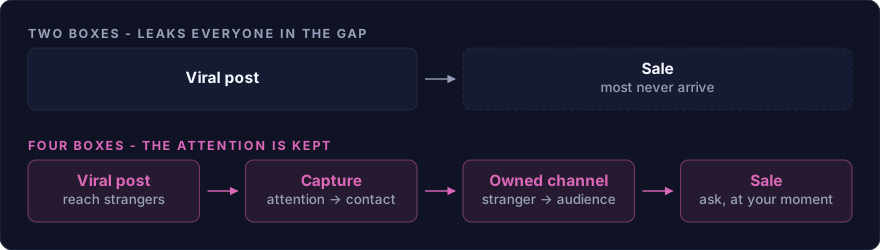
The four-step funnel
Viral post, capture, owned channel, sale - with each arrow given one job it is actually good at. The post earns attention instead of asking for money. Capture converts that attention into a contact. The channel turns time into familiarity. Only then does the ask arrive.
Viral post → Capture → Owned channel → Sale.
Each arrow has one job, and no step is asked to do work it's bad at.
Step 1 - the viral post: reach strangers. This is what feeds are genuinely great at, and nothing else replaces it. The post's job is not to sell - asking a first-touch stranger for money is the two-box funnel's core error. Its job is attention, and one pointer to the next step.
Step 2 - capture: convert attention into a contact. This is the box almost nobody builds, and it's the one that changes the economics. A capture funnel - typically a giveaway with a real incentive - turns a fraction of that viral attention into subscribers: an email address, a Telegram channel join, a Discord membership. The moment is fleeting by design; the feed will bury your post within days (your content dies in 48 hours - capture is how the moment outlives the post). This step is what Ownloop is: the hosted funnel page, the entry mechanics, the verified channel joins, and subscribers that belong to you - legally, as data controller, and practically, with CSV export on every plan.
Step 3 - the owned channel: build the relationship. Between capture and sale sits time, and the owned channel is where that time works for you instead of against you. Messages arrive - no ranking lottery - and they persist. A subscriber who joined from one viral moment hears from you next week, and next month, warming from stranger to audience. This is also where the funnel compounds: every viral post adds to the same list, instead of each post's attention resetting to zero.
Step 4 - the sale: ask, at a moment you chose. By the time the launch message goes out, it's landing with people who know you, in a channel where it reaches all of them at once, with follow-ups that are normal rather than spammy. The mechanics of why this outsells the feed version are in Why launches sell better to a list than to a feed, and the tactical sequence is in How to announce a product drop when the algorithm won't show it.
Why the middle boxes are worth the effort
Because they convert luck into infrastructure. Virality can be played well but never scheduled; the two middle boxes make each jackpot permanent, turning attention into contacts and contacts into an audience still there for the next product. The caveat: a funnel amplifies demand, it cannot create it.
Because they convert luck into infrastructure. Virality is a slot machine - you can play well, but you can't schedule a jackpot. The two middle boxes make every jackpot permanent: the attention becomes contacts, the contacts become an audience, and the audience is still there for the next product, no jackpot required.
The honest caveat, as always: the funnel amplifies demand; it doesn't create it. If step 4 keeps failing with a warm list, the product is the problem - and a direct channel will tell you that faster and more clearly than a feed ever will. That, too, is information worth owning.
The takeaway
Draw the four boxes. Post for reach, capture the moment, warm the channel, and ask when it counts. Two-box creators rent their audience one viral post at a time. Four-box creators keep what their best work earns - and get to use it twice.
Questions
What is a capture funnel, in plain terms?
A page whose only job is to turn a visit into a contact. Typically it offers something worth having and makes joining a channel you own the way to get it, so entering and subscribing are the same action rather than two separate asks.
Does the four-step funnel work without a big following?
Yes, because it changes conversion rather than reach. The funnel converts whatever attention you already earn into contacts that persist; it does not manufacture attention. A smaller creator capturing consistently ends up with a more useful audience than a larger one capturing nothing.