Your Content Dies in 48 Hours on Social. In an Inbox, It Waits.
4 min read
Think about the best post you made last month. The one you spent real time on - the hook, the edit, the caption. Where is it now?
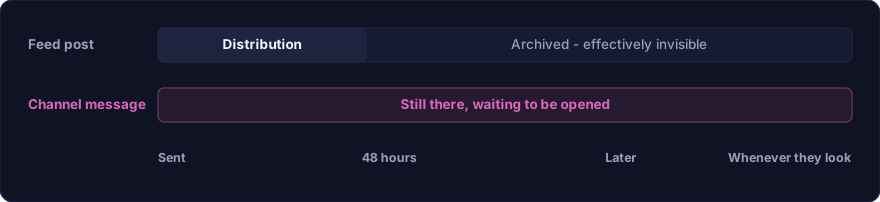
You know where. It's archived on your profile, receiving a trickle of visits from people who go looking. Its distribution life - the period when the platform was actively showing it to anyone - lasted a day or two, maybe less. Then the feed moved on, because moving on is what feeds do.
Now think about the last message you sent to an email list or a Telegram channel, if you have one. It's still there. In the inbox, in the channel history, exactly where it landed - waiting for anyone who hasn't opened it yet.
That difference - decay versus persistence - quietly decides how far every hour of your creative effort travels.
Why do feed posts decay so fast?
Because the feed's job is now. Ranking systems favor recency heavily, so platforms continuously flush the old to surface the new - your post is not deleted, it is outcompeted within hours. The practical consequence is a treadmill: reach exists only while you are posting, and stopping resets it.
Because the feed's job is now. Ranking systems heavily favor recency: a feed full of last week's content is a feed people stop opening, so platforms continuously flush the old to surface the new. Your post isn't deleted - it's simply outcompeted, within hours, by everything newer.
The practical consequence is a treadmill. Reach exists only while you're posting. Stop for two weeks - a launch crunch, a holiday, burnout - and your distribution doesn't pause; it evaporates, and rebuilding momentum starts near zero. Every creator who has taken a break knows the cold restart.
Why do direct messages persist?
Because inboxes and channels are logs, not contests. A message stays until the recipient reads, archives, or deletes it, on their schedule - nothing outcompetes it for its slot, because there is no slot. That changes the economics of effort: the feed rewards output, the list rewards assets.
Because inboxes and channels are logs, not contests. A message in an email inbox stays until it's read, archived, or deleted - by the recipient, on their schedule. A post in a Telegram channel or a Discord announcement stays in the history, scrolled back to by anyone who joined late. Nothing outcompetes it for its slot, because there is no slot: the space belongs to the message.
Persistence changes the economics of effort. A carefully written launch sequence, a genuinely useful guide sent to your list, a welcome message that new subscribers see - these keep working after you stop pushing them. The feed rewards output; the list rewards assets.
What should you do differently, concretely?
Three moves. Match the content to the channel's lifespan - disposable takes on the feed, durable announcements in the channel. Let the feed feed the list, so every sprint on the treadmill captures subscribers who outlive the post. And treat your channel's first messages as the permanent welcome they are.
Match the content to the channel's lifespan. Disposable content - trends, reactions, timely takes - belongs on the feed, where its short life costs nothing. Durable content - announcements, offers, things people need to actually receive - belongs in the channel, where arrival is guaranteed and the message waits to be read. (The step-by-step mechanics of why arrival differs are in Feed reach vs direct reach, explained.)
Let the feed feed the list. The treadmill isn't wasted if every sprint on it captures subscribers who persist after the post dies. That's the escape from starting at zero: a viral moment that adds five hundred channel members keeps paying long after the post's 48 hours are up. The capture mechanic - a giveaway funnel your followers enter by joining your Telegram, Discord, or email list - is what Ownloop exists for, and the subscribers are yours to keep and export on any plan.
Build the archive on purpose. A channel's history is a public record new subscribers scroll. Treat your first messages as the permanent welcome they effectively are.
The takeaway
The feed is a stage: bright, loud, and cleared every night. The list is a shelf: quieter, but what you put there stays. Perform on the stage - that's where the audience finds you. But build on the shelf, because at the end of the year, the stage is empty and the shelf is full.
Questions
How long does a social post keep earning reach?
Mostly the first hours. Feeds are recency machines, so whatever distribution a post earns it earns early, and after that it is effectively archived - reachable by someone who visits your profile deliberately, invisible to everyone else.
What happens to your reach if you stop posting for a few weeks?
It does not pause; it decays. Because distribution depends on publishing, a break means the reach stops rather than waits, and coming back starts near zero. Any creator who has taken a holiday or had a launch crunch knows the cold restart.
Does older content in a channel still get read?
Yes, which is the structural difference. A Telegram channel or Discord server keeps its history, so somebody who joins in March can scroll back to what you posted in January. Nothing outcompeted it for a slot, because there was no slot to lose.