What Actually Happens When You Post: Feed Reach vs Direct Reach, Explained
4 min read
Most advice about "the algorithm" is vibes. Let's do mechanics instead: follow one piece of content through a ranked feed, step by step, and then follow one message through a direct channel. The difference doesn't need dramatizing - it just needs describing.
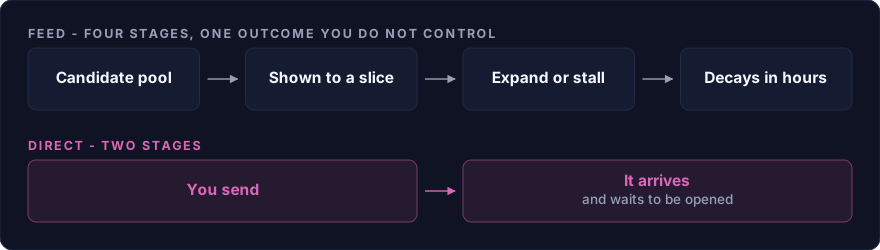
What happens when you post to a feed?
Four stages. Your post enters a candidate pool competing for every slot in each follower's feed; the system shows it to a sample and watches; distribution expands or stalls on that early signal; then recency decay archives it within hours. The result is a probability distribution, not a delivery.
Step 1 - the candidate pool. Your post enters a pool of everything that could appear in each follower's feed: posts from accounts they follow, recommended content from accounts they don't, ads. Your post is one candidate among thousands, per follower, per scroll session.
Step 2 - the sample. The ranking system shows your post to an initial slice of your followers and watches what happens. Engagement in that window - quickly, measurably - decides whether distribution expands or stalls. Most posts stall. That's not failure; it's arithmetic. There are more candidates than slots.
Step 3 - the decay. Feeds are recency machines. Whatever reach your post earns, it earns mostly in the first hours. After that, it's effectively archived - visible to someone who visits your profile on purpose, invisible to everyone else.
Step 4 - the variables you don't control. The weightings change. Formats fall in and out of favor. Outbound links and promotional asks tend to travel worse than native, on-platform content, because the feed is optimized for time on platform - not for your goals. None of this is announced; you infer it from your charts.
Add it up: feed reach is a probability distribution. Some posts massively outperform, most underperform, and the same post on a different day gets a different result. That randomness is fine for discovery - it's the slot machine that occasionally pays out a viral hit. It's a terrible transport layer for anything that must arrive.
What happens when you send to a direct channel?
Two stages: you send, and it arrives - for every subscriber. No candidate pool, no engagement audition, no ranking layer deciding who deserves delivery. The message waits in the channel or inbox until it is opened. Attention still has to be earned, but with no referee in the middle.
Step 1 - you send. A message to your Telegram channel, your Discord server, or your email list.
Step 2 - it arrives. For every subscriber. There is no candidate pool, no engagement audition, no ranking layer deciding who deserves delivery. The message sits in the channel or inbox until the person opens it - hours or days later, still there.
That's the whole flowchart, and its shortness is the point. Direct reach is deterministic: delivery is a function of your list size, not of a scoring system's mood. Attention still has to be earned - people open messages from senders they like and ignore the rest - but the earning happens between you and them, with no referee in the middle.
So which one should a creator build?
Both, for different jobs. The feed is unbeatable at introducing you to strangers; the direct channel is unbeatable at reaching the audience you already earned. The mistake is running both jobs on the feed. Discovery belongs to the platforms; reach you can plan a business around does not.
Both - for different jobs. The feed is unbeatable at introducing you to strangers; no email list ever made anyone go viral. The direct channel is unbeatable at reaching the audience you already earned; no feed ever guaranteed your launch message arrived.
The mistake is running both jobs on the feed. Discovery belongs to the platforms. Reach - the kind you plan a business around - belongs in channels where step 2 is "it arrives."
The bridge between the two is capture: turning the strangers the feed sends you into contacts before the feed moves on. That's what a giveaway funnel on Ownloop does - entry by email, Telegram, or Discord join, subscribers you keep and can export any time. What that list unlocks is catalogued in 10 things you can do with a list that you can't do with followers.
The takeaway
You don't need to guess what the algorithm wants. You need to stop depending on it for the messages that can't afford to get lost. Post to the feed to be found. Send to your list to be heard. The mechanics above are the entire argument - no invented percentages required.
Questions
Why does one post do well and the next one not?
Because reach is decided by a sample. The system shows your post to an initial slice of your followers and expands distribution only if early engagement justifies it, so small differences in that first window produce very different outcomes. The same post on a different day genuinely gets a different result.
Does posting more often make your reach more reliable?
It increases your chances without increasing your reliability, which is a different thing. Every post is a fresh sample, so more posts means more attempts - not a guarantee that any particular message arrives. For anything that has to be received, frequency is not the fix.
Do direct channels have algorithms too?
Not for delivery. A message to an email list or a channel goes to everyone who subscribed; nothing scores it first. Inboxes do sort and filter what has already arrived, and people ignore senders they do not care about - but the deciding happens after delivery, not instead of it.