Email List vs Telegram Channel vs Discord Server: Which Should Creators Build First?
Three channels, one decision, and a great deal of advice that amounts to "it depends." It does depend - but on a small number of things you can actually check, rather than on taste.
Ownloop captures subscribers on Email, Telegram and Discord today, all three on every plan, with no channel paywall between the tiers. So what follows is genuinely a choice about your audience and your working habits, not about what you are paying for.
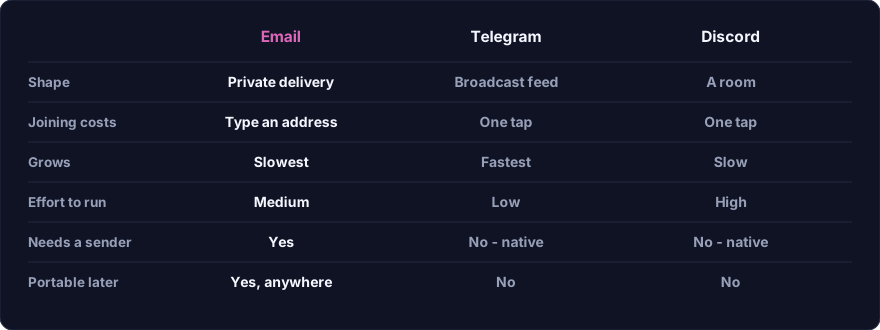
What are you actually choosing between?
Not three versions of the same thing. Email is a private delivery you own outright. A Telegram channel is a broadcast feed people subscribe to. A Discord server is a room where members talk to each other as well as to you. Different shapes, different work, different failure modes.
The shape matters more than the feature list. Email arrives somewhere people already check for things that matter, and it is the only one of the three that is not somebody's app - you can move an email list between providers and the addresses keep working. That independence is real, and it is why email is the default recommendation in almost every guide.
Telegram and Discord trade some of that independence for immediacy and near-zero friction. A message in a channel someone joined arrives as a notification rather than as something competing with work mail. And joining takes one tap for anyone already in the app, which is the single biggest reason a Telegram channel grows faster than an email list from identical traffic.
One honest note before the comparisons: none of the three belong to you either. They have terms, moderation and outages. What separates them from a feed is that no ranking system decides which of your subscribers deserve to hear from you. What owning your audience actually means makes that caveat at length.
When is email the right first channel?
When what you send has substance and you want the least platform risk. Email is the most durable and portable of the three, it suits long-form and considered offers, and an address you hold works regardless of which apps anyone has installed. It is also the slowest to grow.
Choose email first if your plan involves selling something considered rather than impulsive, if you write at any length, or if the idea of your audience living inside one company's app bothers you. Deliverability is a genuine cost - some of what you send will land in spam, and that is the honest limit of the channel - but nothing gets ranked away, and the list is yours in the strongest sense available.
The practical catch is that capture and sending are separate jobs. Ownloop captures the addresses and exports them by CSV on every plan; the sending itself happens in whatever email tool you choose. Ownloop's own direct-messaging features are on the roadmap rather than in the product today, so budget for a sender if email is your first channel. That is not a detail to discover afterwards.
When is a Telegram channel the right first channel?
When your audience already lives in Telegram and you want the shortest path from follower to subscriber. Joining is one tap, broadcasting is free and native, and delivery arrives as a notification rather than an inbox item competing for attention. The cost is that the channel exists inside Telegram.
This is the right first channel for a lot of creators simply because it converts best. No address to type, no confirmation email, no spam folder - a follower taps and is subscribed. If your audience is in a region or a niche where Telegram is ordinary, the difference in capture rate against email is not subtle.
The trade-offs are concentration risk and a shallower relationship. Your channel lives on Telegram's terms, and channel members are more disposable than email subscribers - muting is easy and costs them nothing. Broadcast-only is a feature rather than a limitation, mind: a channel is you talking, which is exactly right if you have no wish to moderate a community.
When is a Discord server the right first channel?
When the value is members talking to each other, not only to you. A server suits an audience that wants somewhere to be - a course cohort, a game, a craft, a paid community. It is the highest-effort option by a distance, because a room with nobody in it looks worse than no room at all.
Pick Discord when community is the product, or close to it. If people want to compare notes, share work, or get help from each other, a server does something the other two structurally cannot. Announcement channels still give you a broadcast surface, so you do not give up the ability to simply tell people things.
Be realistic about the work. Discord needs moderation, seeding and a reason to open it on a Tuesday, and an empty or unmoderated server actively damages the impression you were trying to make. If you would not open it yourself every day for the first two months, choose Telegram or email and revisit this later.
Can you run more than one at once?
Yes, and the plans are built for it - but not on day one. Running two channels well is roughly twice the work of running one, and the common failure is three neglected channels instead of one healthy list. Start with one; add a second when the first is genuinely working.
When you do add one, the useful pattern is division of labor rather than duplication: the fast channel for immediacy, the durable one for substance. Telegram for "it's live, here's the link"; email for the piece explaining why it exists. Sending identical messages to both teaches people to ignore one of them.
What changes between Ownloop plans is capacity, not access. Starter covers one giveaway funnel at a time and up to 1,000 subscribers; Creator raises that to five concurrent funnels and 5,000 subscribers at $18.99 a month; Pro and Agency go further again. All three channels are included on all of them - you can compare the plans directly.
What happens to your list if you switch later?
You export it and take it with you. Subscriber CSV export is included on every Ownloop plan, so the choice you make now is not permanent. The asymmetry worth knowing: an email address is portable to any tool, while a Telegram or Discord membership cannot be moved into another app at all.
This is the part no competitor comparison covers, and it is the one that should actually influence the decision. Email addresses transfer - pick a different sender next year and the list comes with you. Channel memberships do not: nobody can move a Telegram subscriber into an email list on their behalf, because the subscriber has to choose again.
Which is an argument for collecting the email address eventually even if a channel is your first move. Not immediately, and not at the cost of the conversion rate that made you choose Telegram - but the durable version of an audience is the one you can carry between tools. Worth noting too that Ownloop does not import an existing list today, so the direction of travel is outward, not in.
The takeaway
If you want one answer: start with the channel your audience is already in, because capture rate beats theory, then add email once the habit exists. If your audience is genuinely everywhere, start with email, because it is the version of a list that survives you changing your mind about everything else.
Questions
Which of the three grows fastest?
Telegram, in most cases, for a mechanical reason rather than a mysterious one: joining is a single tap with no address to type, no confirmation step and no spam folder in the way. Email asks for more from the visitor at the moment they are least invested.
Do you need a separate email tool as well?
If email is your channel, yes. Ownloop captures the addresses and exports them by CSV on every plan, but the sending happens in whatever email platform you choose - Ownloop's own direct-messaging features are on the roadmap rather than in the product today. Telegram and Discord need no extra tool, because broadcasting is native to both.
What if your audience is split across several platforms?
Pick the channel the largest share of them already use, because capture rate beats theory every time. Splitting your effort across two channels from the start usually produces two half-built lists. Add the second once the first has a habit attached to it.