How to Protect Your Audience From Algorithm Changes
6 min read
Every creator eventually runs into the same wall. The audience took years to build, and losing access to it takes one ranking decision you were never consulted on. Nothing about your work changed - what changed is the route between you and the people who chose to follow you.
Why does your reach drop overnight?
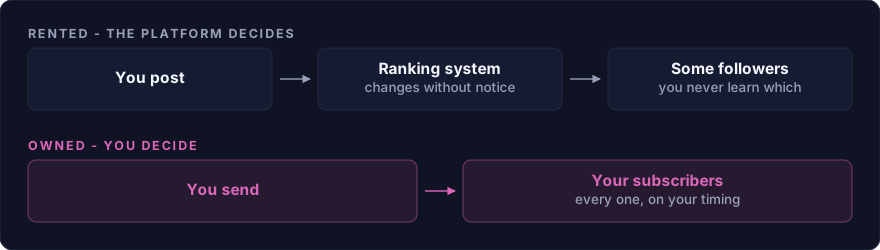
Because you never had a direct line to your followers in the first place. Every post reaches people through a ranking system that decides who sees what, and that system changes without warning. When it shifts, your reach shifts with it - not because your audience left, but because the road to them was rerouted.
The mechanics differ; the shape does not. A ranking change reweights what gets distributed, and a post that would have found most of your followers last month finds a fraction of them today. Nobody tells you, because nothing was done to you specifically. The rules simply moved.
Third-party measurement puts some scale on that fraction. Analyzing Facebook and Instagram posts published between May 2024 and May 2025, Socialinsider measured an average Instagram reach rate of 3.5% (opens in a new tab) - the share of an account's followers that a typical post actually reached. Two caveats travel with the number: it is a level rather than a decline, and Socialinsider itself notes that reach data from any third-party tool is an estimate. Read it as an order of magnitude, not a promise.
Content can also fall out of discovery quietly, with no notice and no appeal, producing a slow decline in new followers that is hard to tell apart from a bad run of posts. Accounts get suspended after a single review, locking a creator out of an audience built over years. And platform policy shifts on its own schedule: what was rewarded last quarter can be penalized this one, which turns strategy into a permanent scramble.
None of this is malice, and none of it is fixable from the inside. It is the ordinary operating behavior of systems that sell distribution. The useful conclusion is narrower than it sounds: publishing on platforms you do not control is fine, as long as the only thing you leave there is attention - not the connection itself.
What does 'owning your audience' actually mean?
It means holding a contact you can use without asking a feed for permission - an email address, a Telegram subscriber, a Discord member. You are not owning the platform. You are owning the route: a way to reach people directly, on your timing, with no ranking change standing in between.
That distinction deserves an honest caveat, because "own your audience" is usually sold without one. Email, Telegram and Discord are platforms too. They have terms, moderation, outages and deliverability rules, and none of them belong to you either. What separates them is structural rather than moral: there is no ranking system deciding which of your subscribers deserve to hear from you. If someone subscribed, a message you send is a message they receive.
That is a difference in kind rather than a claim of perfection, and it is worth being precise about which. Email loses some mail to spam filters: EmailToolTester's deliverability testing puts average inbox placement at 83.1% across fifteen email services (opens in a new tab), so roughly one message in six does not land where it was sent. That is what "deliverability rules" means in practice, and it is a real cost of the channel. Set it beside the 3.5% of followers a typical feed post reaches, though, and the two are not the same problem: one channel loses a minority of messages to filters, the other shows your post to a small minority of the people who chose to follow you.
The second difference is portability. A follower count cannot be moved anywhere - it exists only inside the platform that issued it. A list of contacts can be exported and taken elsewhere. Ownloop includes subscriber CSV export on every plan for exactly that reason: an audience that cannot leave with you is not really yours. The FAQ covers what that export contains.
How do you move followers into channels you own?
You give people a concrete reason to take one extra step. In practice that is a giveaway funnel: a hosted entry page where entering means joining a channel you own - handing over an email address, subscribing to your Telegram channel, or joining your Discord server, with membership verified.
The mechanic works because it trades something specific for something specific. Asking followers to "join my newsletter" asks them to do you a favor. A giveaway gives them a reason of their own, and the entry step is the capture. Ownloop hosts the entry page, so there is no site to build or maintain, and it verifies that the join actually happened rather than taking a claim at face value.
What you are left holding afterwards is the whole point. Not a click you cannot follow up on, but a subscriber list you can message directly - across Email, Telegram and Discord, the three channels that are live today, on every plan.
One limitation is worth knowing before you start. Ownloop captures new subscribers as they enter your funnels; bulk-importing a list you already hold is not available today. If migrating an existing audience is the thing you actually need, that gap matters more than any feature list. About Ownloop explains what the product does and does not do yet.
Who owns the subscriber data you collect?
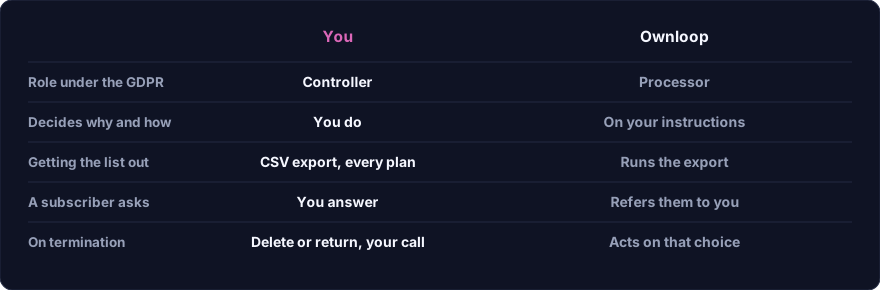
You do, and that is a legal position rather than a slogan. For the subscribers you capture, you are the data controller and Ownloop is your processor: we handle that data on your instructions, to provide the service, and not for our own purposes. We do not sell it.
In plain terms, controller means you decide why the data exists and what happens to it. Processor means we act on your instructions and nothing further. The split matters most at the moments creators rarely plan for in advance - when you want to export everything, when a subscriber asks to be deleted, or when you decide to leave.
It is written down rather than implied. The Privacy Policy sets out what is collected and why, and the Data Processing Agreement covers the controller and processor roles, the safeguards that apply to transfers, and what happens to subscriber data when the relationship ends. For your own account and billing data the roles reverse and Ownloop is the controller; the two are deliberately kept apart.
This is not the usual thing a link-in-bio product writes about, because a link page rarely holds anything worth arguing over. The moment a tool starts holding the contact details of your audience, the question of who controls them stops being paperwork.
None of this makes platform reach worthless. It makes it the top of the funnel rather than the whole of it: keep publishing where the discovery happens, and convert the attention it earns into contacts that survive the next ranking change.
Ownloop starts at $6.99 a month on Starter, with a 14-day free trial on the Creator and Pro plans. There is no free tier, and no cut of what you earn. You can compare what each Ownloop plan includes before you decide, or read the full FAQ first.
Questions
Can you lose your whole audience if your account is banned?
Your followers, yes - the follow graph belongs to the platform, so if the account goes, they go with it. That is exactly what an owned list insures against: subscribers live outside any single platform account, and Ownloop includes subscriber CSV export on every plan, so a copy of the list can sit somewhere you control.
Is email actually safer than social platforms?
Not immune - email has terms, providers and spam filtering, and some of what you send will not reach the inbox. What it does not have is a ranking system deciding which of your subscribers deserve to hear from you. The failure mode is a filter you can measure, rather than a distribution decision you never see.