Why Launches Sell Better to a List Than to a Feed
4 min read
First, the honest caveat that most articles in this genre skip: a direct channel doesn't create demand. If nobody wants what you're selling, an email list will tell you that faster than a feed will. What a direct channel changes is what happens when people do want it - how many of them hear about it, when, and how many times.
That's what a launch actually is: a timing problem, a reach problem, and a follow-up problem. Feeds are structurally bad at all three. Lists are structurally built for them.
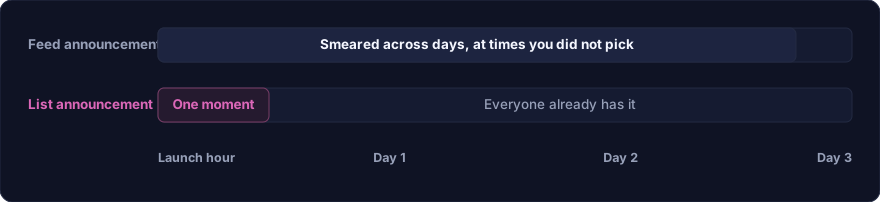
Why do launch posts underperform in the feed?
Three mechanics stack against them. Sampling shows the post to a fraction of your followers and expands only on strong early engagement, which launch posts rarely earn. Timing drift scatters whoever does see it across days. And platforms optimizing for time on platform have little reason to amplify an outbound link.
Three mechanics stack against you.
Sampling. A feed shows your post to a fraction of your followers and expands only if early engagement justifies it. Launch posts - "here's my product, here's the link" - are not engagement bait, so they rarely earn the expansion. The post that mattered most reaches the smallest slice.
Timing drift. Even the followers who do see it, see it whenever the algorithm schedules them - hours or days after your launch moment. A launch is supposed to be an event; the feed turns it into a rumor that spreads at random.
Promotion penalty. Platforms optimize for time-on-platform. Posts with outbound links and purchase asks work against that goal, and creators have watched such posts underperform for years. You're selling in a venue whose owner would prefer you didn't.
What changes when you launch to a list?
All three invert. The message reaches every subscriber, so your day-one audience is known and plannable. It lands at the moment you choose, which is the only way scarcity works. And follow-up becomes a normal sequence - announcement, reminder, last call - rather than a fresh lottery ticket each time.
The three problems invert.
Full reach. The launch message goes to every subscriber - the whole audience you built, not a ranked sample of it. Whatever your list size is, that's your day-one launch audience. Known. Plannable.
Your timing. The message lands at the moment you choose. Scarcity and urgency - "48 hours," "first 50" - only work when everyone's clock starts together. A list is the only channel where it does.
Follow-up as a sequence. Real launches aren't one message. Announcement. A reminder to the people who didn't open. A last call as the window closes. In a channel or inbox this is a normal, expected rhythm. In a feed, each of those is a separate lottery ticket, and reposting the same offer reads as spam to the algorithm and the audience both.
There's a quieter fourth advantage: the inbox context. A feed is scrolled with a thumb, half-attention, between strangers' content. A message in a channel someone chose to join is read on purpose. The same offer, read intentionally instead of glimpsed, does not perform the same.
When should you start building the list - and how?
Before the launch. A list assembled during a launch arrives cold; one built in the months before arrives already knowing you. The pipeline worth drawing: viral content brings strangers, a capture funnel converts them into subscribers, the owned channel warms them, and the launch message sells.
Before the launch. The list you build during a launch arrives cold; the list you build in the months before arrives already knowing you. That's the pipeline worth drawing: viral content brings strangers → a capture funnel converts followers into subscribers → the owned channel warms them → the launch message sells.
The capture step in the middle is what Ownloop does: a giveaway funnel your followers enter by joining your Telegram or Discord or dropping an email - subscribers you own, on every plan, exportable any time. The mechanics, pricing, and the question of who legally owns the subscriber data (you do, as data controller) are in the FAQ and About pages, stated plainly.
The takeaway
Feeds are for being discovered. Lists are for being heard - on launch day, by everyone, at the hour you chose, with the follow-ups that actually close. If you're planning a drop, the highest-leverage work isn't the launch post. It's the hundred days before it, moving the people who already like you into a channel where the launch can't be lost in a ranking system's shuffle.
Questions
How far ahead of a launch should you start building a list?
Before the launch is planned, ideally. A list assembled during a launch arrives cold and has no reason to trust you yet; one built over the preceding weeks or months already knows who you are. The practical point is that a list cannot be built at the moment you need it, which is the moment most people start.
What does a launch sequence actually look like?
The common shape is three messages: the announcement, a reminder aimed at people who did not open the first, and a last call as the window closes. In a channel someone chose to join, that rhythm is normal. In a feed each one is a separate roll of the dice.
Will launching to a list work if the product is not good?
No, and it will tell you so quickly. A direct channel amplifies demand; it does not create it. If a warm list that knows you does not buy, the honest conclusion is about the offer rather than the channel - which is information worth having sooner than a feed would give it to you.