Who Owns Your Subscriber Data? The Question Nobody Answers
4 min read
"Own your audience" is on every creator tool's homepage. Now try to find, on those same sites, a sentence that says who legally controls the subscriber data - who decides what it is used for, whether the tool can use it for its own purposes, what happens to it if you leave.
Mostly you will find silence, because the honest answer is awkward. This article explains the two words that settle the question - controller and processor - and why a creator should want them in writing before trusting any tool with their audience.
What do controller and processor actually mean?
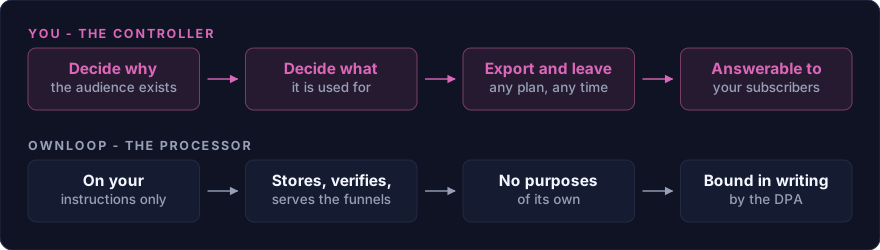
Data-protection law splits every data relationship into two roles. The controller decides the purposes - why the data is collected, what it is used for, how long it is kept. The processor handles data only on the controller's instructions, for the controller's purposes. Whoever is controller of your subscriber data effectively owns the relationship.
The roles are not branding; they carry defined legal obligations, and they cannot both be vague at once. For any list of subscribers, someone is deciding what that data is for - and if the tool's documents do not say it is you, the working assumption should be that it is the tool.
The distinction has teeth in the scenarios creators actually worry about. Can the platform message your subscribers, cross-promote to them, or fold them into its own audience? A pure processor cannot - those would be its own purposes. Can you take the data and leave? A controller can, by definition; a user of someone else's audience database often cannot.
How does Ownloop answer it?
In writing: for subscriber data collected through your funnels, you are the controller and Ownloop is your processor - stated in the privacy policy and a signed-ready data processing addendum. Your subscribers are your data, handled only to run the service on your instructions, and exportable on every plan.
The concrete version of the split: you decide why the audience exists and what it is for; Ownloop stores, verifies and serves it so the funnels work - and does not message your subscribers, use them for its own promotion, or keep purposes of its own beyond operating the service. The privacy policy and the data processing addendum put the roles in enforceable language rather than homepage language.
Portability closes the loop: CSV export on every plan means the controller role is not theoretical. The list moves when you do.
Plain-words caveat: this article explains roles; it is not legal advice, and creators with specific compliance duties - running their own newsletters, handling audience data in regulated niches - should read the actual documents and, where it matters, ask someone qualified.
What should you ask any audience tool before trusting it?
Four questions, answerable from documents rather than marketing: Who is the controller of subscriber data collected through me? Can the platform contact or monetize my subscribers for its own purposes? Can I export everything, on every plan? What happens to the data when I leave?
Tools that have good answers put them in privacy policies and DPAs, because those are the documents the answers are enforceable in. Tools that do not will answer with the homepage slogan - which is precisely the tell. "Own your audience" printed above a terms page that makes the platform the controller is not a contradiction the reader is supposed to notice.
The wider concept - what ownership means across reach, portability and control - is the subject of what is audience ownership. This article is the legal leg of that stool, and it is the one competitors are quietest about.
Whoever controls the data owns the audience, whatever the homepage says. Ask the four questions, read the two documents, and treat silence as an answer. Yours should be the only name in the controller's seat.
Questions
Does being the data controller create obligations for the creator?
Yes - controllers carry duties: honest collection, respecting unsubscribes and deletion requests, using the data for the purposes people expected. They are the obligations of genuinely owning a relationship, and a good processor's tooling helps you meet them.
Is a platform's follower list ever the creator's data?
No - follow graphs are the platform's data about connections on its service, governed by its terms. That is the structural difference between a following and a captured list, and why only one of them can be exported.
What is a data processing addendum, in one sentence?
A DPA is the contract that binds the processor to act only on the controller's instructions - the enforceable version of "your data stays yours," and its absence from a tool that handles audience data is itself informative.