What Is Audience Ownership? A Plain-Words Definition
4 min read
"Own your audience" is the most repeated advice in the creator economy and one of the least defined. Everyone says it; almost nobody says what it means, which lets it drift into a vibe - something about email lists, something about algorithms being bad.
It has a precise meaning. Here it is, in plain words, with the parts that usually get skipped.
What does audience ownership actually mean?
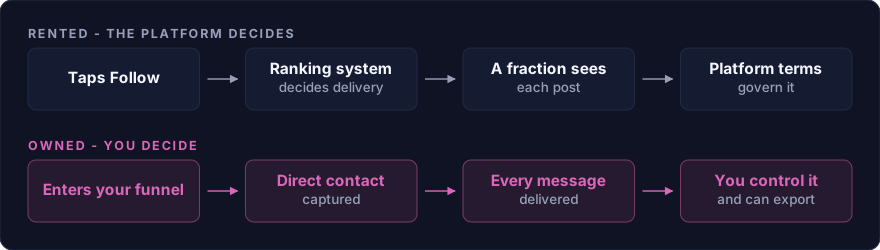
Audience ownership means you hold the direct line to your audience yourself: contact points - email addresses, channel memberships - that you can reach without a platform's ranking system deciding delivery, that you can export and take elsewhere, and that you control as a matter of defined legal role, not platform permission.
Three tests separate owning an audience from renting one. Reach: can you put a message in front of these people on purpose, without an algorithm choosing who sees it? Portability: can you take the list with you - export it, move it to another tool, keep it if any single account disappears? Control: who decides what happens to this data - you, or a platform's terms of service?
A social following fails all three. The platform samples who sees each post, the follow graph cannot be exported, and the platform's terms - not yours - govern the relationship. None of that is a scandal; it is the deal that buys you free discovery. But it means a follower count is an audience you rent.
An email list, a Telegram channel, a Discord server pass all three. Messages arrive without a ranking layer, the contacts move with you, and the rules of the space are yours.
Is "ownership" just a metaphor?
No - for captured subscriber data it is a defined legal role. When someone joins your list through a funnel you run, you are the data controller of that subscriber data: the party who decides why it is collected and how it is used.
This is the part most "own your audience" advice never mentions, because most tools never put it in writing. Under data-protection law, the party who decides why personal data is collected and what it is used for is the controller. When a fan enters your giveaway on Ownloop and becomes your subscriber, that controller is you. Ownloop acts as your processor - handling the data on your instructions to run the service, and for nothing else. The split is written down in the privacy policy and data processing addendum, not implied.
Compare that to a follow: there, you are not the controller of anything. You are the subject the platform's data is about.
Portability makes the legal role practical. Subscriber CSV export is included on every plan - the list is never hostage to the tool that helped build it.
What audience ownership is not
It is not anti-platform. Feeds are unmatched at introducing you to strangers, and no owned channel replaces that. Ownership is the second step, not the enemy of the first: discovery happens on rented land, the relationship moves to owned land.
It is not total independence either - honesty matters here. An email list still depends on email infrastructure; a Telegram channel still depends on Telegram existing. The difference is narrower and more useful: in owned channels, no ranking system sits between you and a subscriber deciding whether your message is delivered. You depend on the pipe, not on an audition.
And it is not a number to vanity-track. A thousand captured contacts you never message are as idle as a thousand followers. Ownership creates the option to reach people; using it is still your job.
How do creators start owning their audience?
By capturing: giving followers a concrete reason to hand over a direct contact point. In practice that is a giveaway funnel - an incentive, a light entry step, and subscribers you keep after the campaign ends.
Nobody joins a channel because a bio says "join my channel." They join when something is on the other side. That is why capture almost always runs on an incentive - and why the giveaway funnel is the standard mechanic: a prize your audience genuinely wants, an entry step as light as joining your Telegram or Discord or typing an email, and a subscriber that remains after the giveaway ends.
That capture step is what Ownloop does - the hosted funnel page, the verified channel joins, and Email, Telegram and Discord subscribers that are yours by every test above. What a captured list unlocks, item by item, is in 10 things you can do with a list that you can't do with followers.
So the next time someone says "own your audience," you can replace the vibe with the three tests: reach on purpose, portability, control. Whatever passes them, you own. Whatever fails them, you are renting - which is fine, as long as you know which is which.
Questions
Is a YouTube subscriber an owned contact?
No - it fails all three tests. YouTube decides which subscribers see a video, the subscriber list cannot be exported as contacts, and the relationship is governed by YouTube's terms. Platform "subscribers" are followers by another name.
Can an owned audience be lost?
Yes, by neglect or misuse - people unsubscribe from channels that spam or go silent for months. Ownership removes the algorithm between you and your audience; it does not remove the need to be worth hearing from.