Your Best Traffic Day Is Unplanned. Keep a Funnel Running.
5 min read
Ask a creator when their last big traffic day was and you will usually hear about something they did not schedule: a post that travelled further than the ten before it, a mention from a bigger account, a video that found an audience three weeks after it went up.
Now ask what was running on the day it happened. For most creators the answer is nothing - the funnel from the spring campaign closed in April, and the next one opens whenever the next campaign does. The attention arrived, found no door, and left.
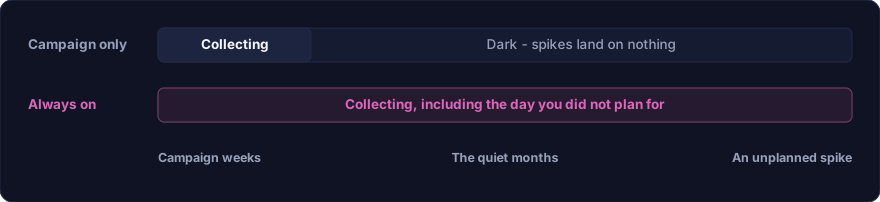
Why does it matter when a funnel is running?
Because the days that produce the most attention are mostly the days you did not plan. A funnel that only exists during campaigns is dark for most of the year, so every unscheduled spike converts into nothing. Capture is a readiness problem before it is a marketing one.
Campaign thinking treats capture as an event: choose a prize, run it for two weeks, draw a winner, take the page down. That is a reasonable way to run a campaign and a poor way to run infrastructure, because it assumes attention arrives on your calendar.
It does not. Feeds are recommendation machines now, which means the same shift that thins your baseline reach also produces occasional outsized results with no warning - the mechanics are in why organic reach keeps falling. You cannot schedule the good day. You can only decide, in advance, whether there is somewhere for it to go.
The stages a spike passes through once it does have somewhere to go are drawn out in the creator sales funnel nobody draws. This article is about the clock rather than the stages: that funnel only helps if it was already on.
Should a giveaway run permanently or only during campaigns?
Both, doing different jobs. A campaign is loud, deadline-driven and promoted hard, and it produces the bursts that make a channel feel alive. An always-on funnel is quiet, permanently linked, and produces a trickle plus every unplanned spike. Most creators run campaigns and skip the quiet one.
The two shapes are not competitors, and the mistake is treating them as one choice. A campaign concentrates arrivals - which is precisely what a Discord server wants, as in growing a server with a giveaway. Nothing about an always-on funnel replaces that.
What the always-on funnel does is remove the zeros between campaigns. It sits wherever your audience already passes - your bio, your pinned post, the end of your videos - and it collects on ordinary Tuesdays, from the old post someone found through search, and on the day something unexpectedly travels.
Practically it is one page you leave up rather than take down, and the difference between running it and not is entirely a decision about whether the page has an end date.
What do you put up as a prize for a funnel that never ends?
Something repeatable and cheap to fulfill rather than a single spectacular item: a monthly draw for your own product, a recurring session, access. The relevance rule from campaign prizes still holds, with one addition - an evergreen prize has to survive being given away again next month.
The prize logic does not change, and the framework in how to pick a giveaway prize applies unaltered: relevance filters for fans, and the cheapest prizes a creator owns are usually the most relevant. What changes is the repeat requirement. A one-off grand prize cannot anchor a permanent funnel, because you cannot give it away twelve times.
That constraint pushes you toward exactly the prizes that work best anyway - your own product, a seat, a review, a role - because those are the ones you can offer on a cadence without the cost compounding. Publish the cadence on the page: a draw every month, stated plainly, gives the funnel a real deadline every month instead of no deadline at all.
Keep the entry step identical to a campaign's: joining your Telegram or Discord, or leaving an email address, with the join verified rather than taken on trust. On Ownloop that is the same funnel either way - the only difference is that you do not close it.
When is a campaign still the right shape?
When you need concentration rather than coverage: a launch that needs an audience assembled by a date, a new server that needs enough people arriving together to feel inhabited, or a prize too large to repeat. Urgency is a real mechanic, and a permanent offer has less of it.
This is the honest limit of the argument. An always-on funnel trades intensity for coverage, and there are moments worth more intensity: the weeks before a launch, the opening of a community, the one big prize a year that earns attention no monthly draw ever will. A deadline people believe does work that a standing offer cannot.
So the shape most creators end up wanting is both - campaigns when there is something to concentrate around, and a quiet funnel running the rest of the time so the year has no dark months in it. Where that quiet funnel earns its keep is on the day nobody planned, when the alternative was a spike that faded on schedule with nothing kept.
You cannot arrange to be discovered on a Tuesday. What you can arrange is that the door is open when it happens - one funnel, left running, quietly turning the days you did not plan into subscribers you keep. The campaigns are still worth running. They just should not be the only weeks of the year that collect anything.
Questions
How do you draw a winner when the giveaway never ends?
On a published cadence rather than on a single closing date - a draw every month or every quarter, stated in the terms before anyone enters. The cadence is what gives a permanent funnel its deadlines, and creators who leave it unstated tend to find entrants stop believing a draw happens at all.
Do returning visitors get tired of seeing the same offer?
The people who see it repeatedly are mostly people who already entered, and they are not the audience it is aimed at - a standing funnel works on newcomers and on the old content that keeps finding them. Rotating the prize each cycle handles the rest, and doubles as a way to learn which prize your audience responds to.
Can a campaign and an always-on funnel run at the same time?
Yes, and they do different jobs while they do: the campaign takes the promotion and the urgency for a few weeks, while the standing funnel keeps collecting from everything else. The one thing worth avoiding is two loud offers competing for the same attention in the same week.